Stop Wrestling With PLCs: How IoT and Cloud AI Are Making Production Line Monitoring Radically Simple

Every minute of untracked downtime is money walking out the door. But until now, getting real visibility into your production lines meant six-figure projects, PLC integrations, and IT headaches that could stretch for months. That era is over.
If you run a manufacturing floor, you already know the frustration. You know there's waste hiding in your production lines — unplanned stops, mysterious slowdowns, operators waiting on machines that nobody realized went idle twenty minutes ago. You can feel it in missed targets and late shipments.
But when you've looked into solving it, the answer has always been the same: hire a systems integrator, wire up your PLCs, build out on-premise servers, configure SCADA systems, and write custom software to pull data from dozens of different machine protocols. The price tag? Tens of thousands of dollars per line — sometimes hundreds of thousands — with a timeline measured in months, not days.
For small and mid-sized manufacturers especially, that math has never worked. So you keep running blind.
What if you could monitor an entire production line in 15 minutes, for the cost of a nice dinner out?
That's the premise behind IoTFlows BeamTracker — and after seeing what it does for real factories, it's hard to argue with the results.
But before we get into the product itself, let's talk about why production monitoring matters so much, and why the traditional approach has kept so many manufacturers stuck in the dark ages.
The Hidden Cost of "We'll Figure It Out Later"
Here's a number that should keep every plant manager up at night: the average manufacturer operates at only 60% OEE (Overall Equipment Effectiveness). World-class facilities hit 85% or above. That gap — the 25 percentage points between average and excellent — represents an enormous amount of lost revenue hiding in plain sight.
But what is OEE, exactly?
Understanding OEE: The Single Most Important Manufacturing Metric
OEE is the gold standard for measuring manufacturing productivity. It combines three critical factors into a single percentage that tells you how effectively your equipment is being used:
Availability measures the percentage of scheduled time that your equipment is actually running. Every unplanned stop, changeover delay, or material shortage chips away at this number. If your shift is 8 hours but the machine only ran for 6, your availability is 75%.
Performance measures whether your equipment is running at its maximum designed speed. Even when a machine is "running," it might be cycling slower than it should — due to minor stops, reduced speed settings, or operator hesitation. If your machine can produce 100 parts per hour but is only averaging 80, your performance is 80%.
Quality measures the proportion of good parts versus total parts produced. Scrap, rework, and defects all drag this number down. If you made 1,000 parts but 50 needed rework, your quality rate is 95%.
OEE = Availability × Performance × Quality
So if your availability is 75%, performance is 80%, and quality is 95%, your OEE is just 57% — meaning nearly half of your manufacturing capacity is being wasted.
The problem? Most manufacturers don't know their OEE because they can't measure it. They're estimating production counts on clipboards. They're discovering downtime events hours after they happened. They're guessing at cycle times.
You can't improve what you can't measure.
Why Traditional Monitoring Has Failed Most Manufacturers
The manufacturing world has had monitoring solutions for decades. SCADA systems, MES platforms, and PLC-based data collection have been around since the 1980s. So why are most factories still running blind?
The PLC Problem
Programmable Logic Controllers are the brains of most automated equipment. They control everything — motor speeds, valve positions, sequence timing. And yes, they contain valuable production data. But getting that data out of a PLC and into something useful is where things fall apart.
Every PLC manufacturer uses different communication protocols. Allen-Bradley speaks one language. Siemens speaks another. Mitsubishi, Fanuc, Omron — all different. Connecting to them requires specialized knowledge of each protocol, custom programming, and often expensive middleware to translate between systems.
Then there's the access problem. Many manufacturers (understandably) don't want anyone touching their PLC programs. One wrong configuration change could shut down a line. So even if you could pull data from the PLC, your maintenance team may refuse to let anyone near it.
The Integration Tax
Traditional monitoring projects don't just require PLC connections. They need on-premise servers to store and process data, networking infrastructure to move it around the plant, custom dashboards to visualize it, and ongoing IT support to keep everything running.
Each of these layers adds cost, complexity, and risk:
- Servers and infrastructure: $10,000–$50,000+ for hardware alone
- Systems integration: $20,000–$100,000+ for custom PLC connections
- Software licensing: $5,000–$30,000+ annually for SCADA/MES platforms
- IT staffing: Ongoing costs for maintenance, updates, and troubleshooting
- Timeline: 3–12 months from project kickoff to useful data
For a single line. Multiply that across your facility and the numbers become staggering.
Legacy Equipment: The Elephant in the Room
Here's the kicker — many production lines include older equipment that predates modern networking entirely. Machines from the 1990s (or earlier) may not have Ethernet ports, may use obsolete communication protocols, or may have no digital interface at all.
Connecting these legacy machines to a monitoring system often requires additional hardware (protocol converters, I/O modules, edge gateways) and even more custom engineering. It's not uncommon for a single legacy machine to cost $5,000–$15,000 just to "digitize."
The IoT Revolution: A Different Approach Entirely
What if, instead of going through the machine's control system, you could simply observe the machine from the outside?
That's the fundamental insight behind the new generation of IoT-based production monitoring. Rather than integrating with PLCs, wiring into I/O ports, and building complex data pipelines — you place a smart sensor on the line and let it do the work.
It sounds almost too simple. But the technology has finally caught up with the idea.
Modern IoT sensors combine precision measurement (laser, vibration, acoustic, or visual detection) with built-in wireless connectivity (WiFi, 4G/LTE, or 5G) and cloud-based analytics platforms powered by AI. The sensor captures what's happening on the production line. The cloud makes sense of it. And you get actionable insights delivered to any device, anywhere.
No PLC integration. No on-premise servers. No systems integrator required.
Enter BeamTracker: Production Monitoring That Just Works
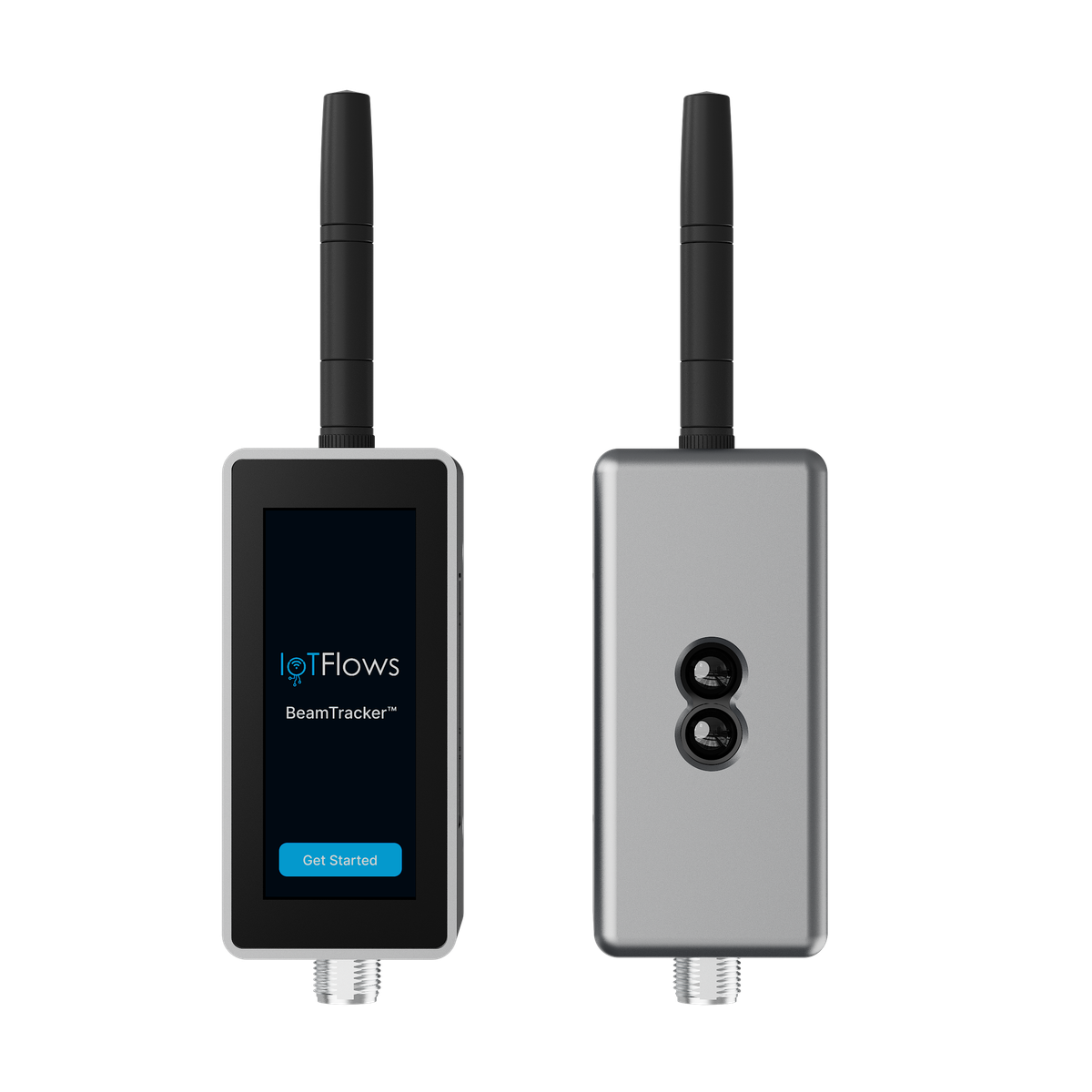
IoTFlows BeamTracker is a cloud-based industrial laser sensor designed from the ground up for one purpose: giving manufacturers instant, accurate production visibility — without the complexity.
Here's how it works in practice.
Mount It, Power It, Done
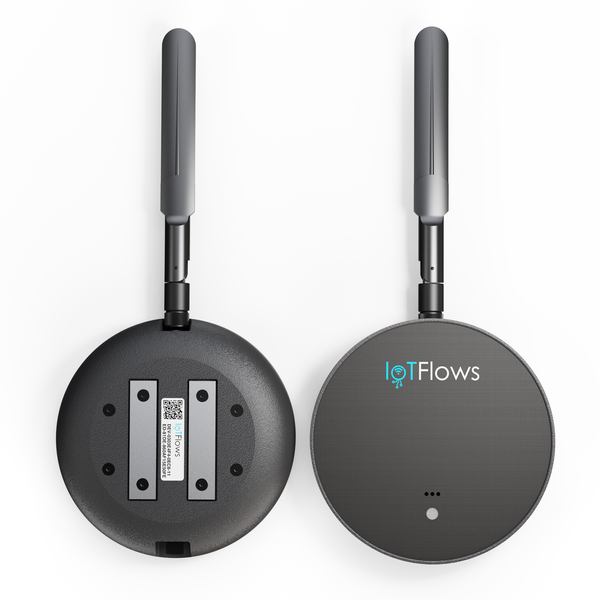
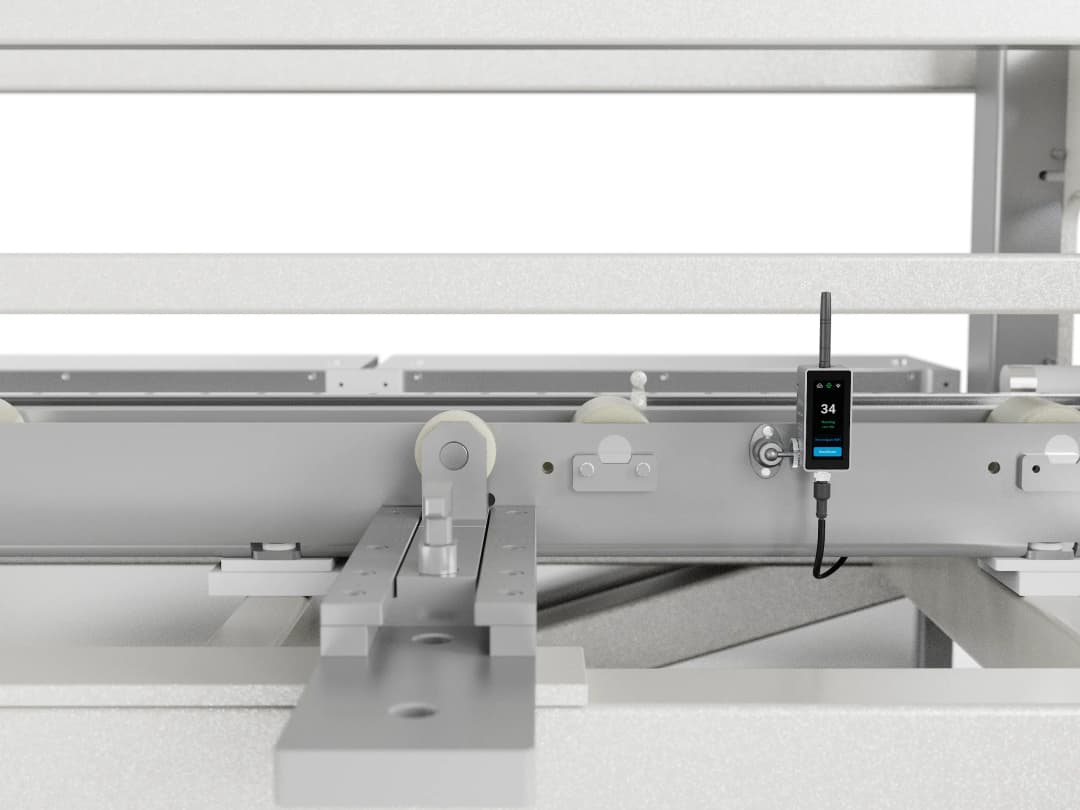
BeamTracker is a compact, industrial-grade device with a built-in LiDAR sensor and touchscreen display. You mount it so that its laser beam crosses the path where your parts, packages, or products flow. Every time something breaks the beam, BeamTracker registers a count and timestamps the event.
The entire installation process typically takes 5 to 15 minutes:
- Mount the device using the included bracket
- Connect power via the M12 connector (12–24V DC)
- Connect to your WiFi network (or use a 4G/LTE router if WiFi isn't available)
- Calibrate the detection range through the built-in touchscreen
That's it. No electrician. No PLC programmer. No network engineer. No systems integrator.
Within minutes of powering on, your production data starts flowing to the IoTFlows cloud dashboard — accessible from any web browser or mobile device, anywhere in the world.
Built for the Factory Floor
Factories aren't gentle environments. Dust, moisture, vibration, temperature swings — consumer-grade electronics wouldn't last a week. BeamTracker is engineered specifically for these conditions:
- IP67 rated — fully sealed against dust and protected against temporary water immersion
- Operating range of -20°C to +70°C (-4°F to +158°F)
- Vibration resistant construction with aluminum alloy housing
- Detection range of 5 cm to 8 meters — flexible enough for everything from small component lines to large conveyor systems
- ±2% counting accuracy with update rates up to 250 Hz
And if it loses connectivity? BeamTracker stores data locally for up to 6 hours and automatically syncs when the connection is restored. No data lost, ever.
What You See: Cloud-Powered Production Intelligence
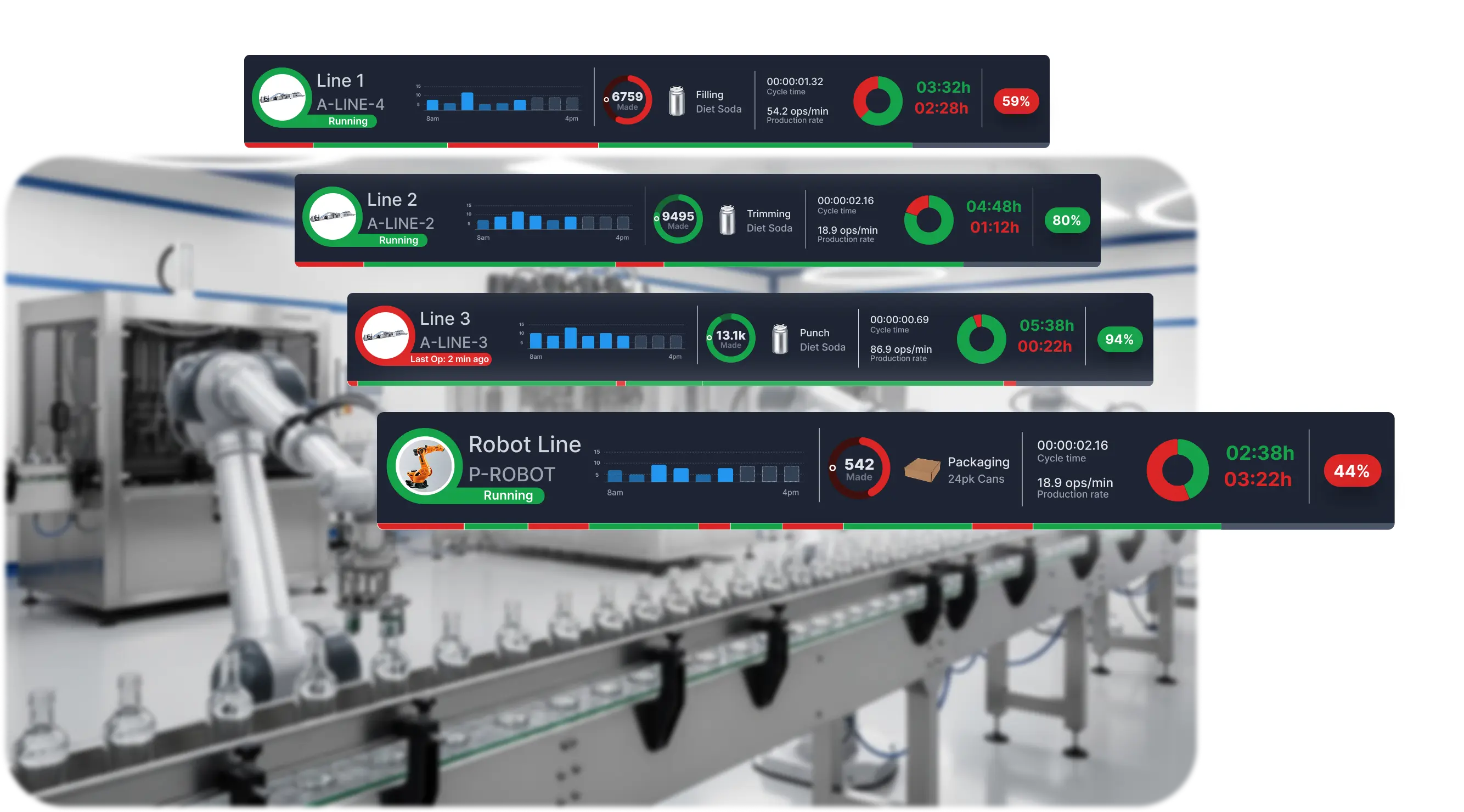
The sensor is only half the story. Where BeamTracker truly shines is in what happens with the data once it reaches the IoTFlows cloud platform.
Real-Time Production Dashboards
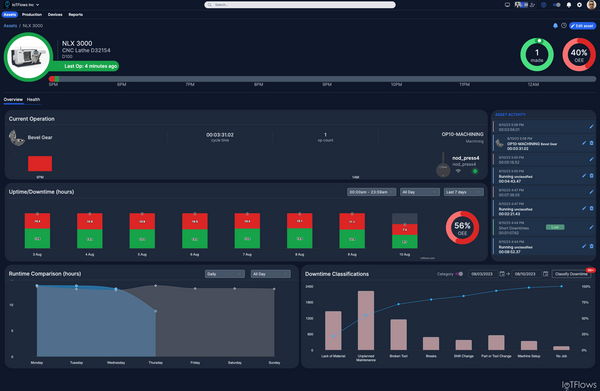
The moment BeamTracker is online, you get a live view of your production line. Parts per minute, parts per hour, running vs. stopped status — all updating in real time. You can see at a glance whether you're on pace to meet your shift target or falling behind.
No more walking the floor to check on machines. No more asking operators for manual counts. No more discovering at the end of the shift that you're 500 units short.
Automatic Downtime Detection and Tracking
This is where things get really powerful.
BeamTracker continuously monitors the time between parts. If no part passes through the beam for longer than a configurable threshold, it automatically registers a downtime event — capturing the exact start time, end time, and duration.
Every single stop is recorded, whether it lasts 30 seconds or 3 hours. Over time, this creates a comprehensive map of exactly when, where, and how often your production lines go down.
Root Cause Analysis: Finding the "Why" Behind Every Stop
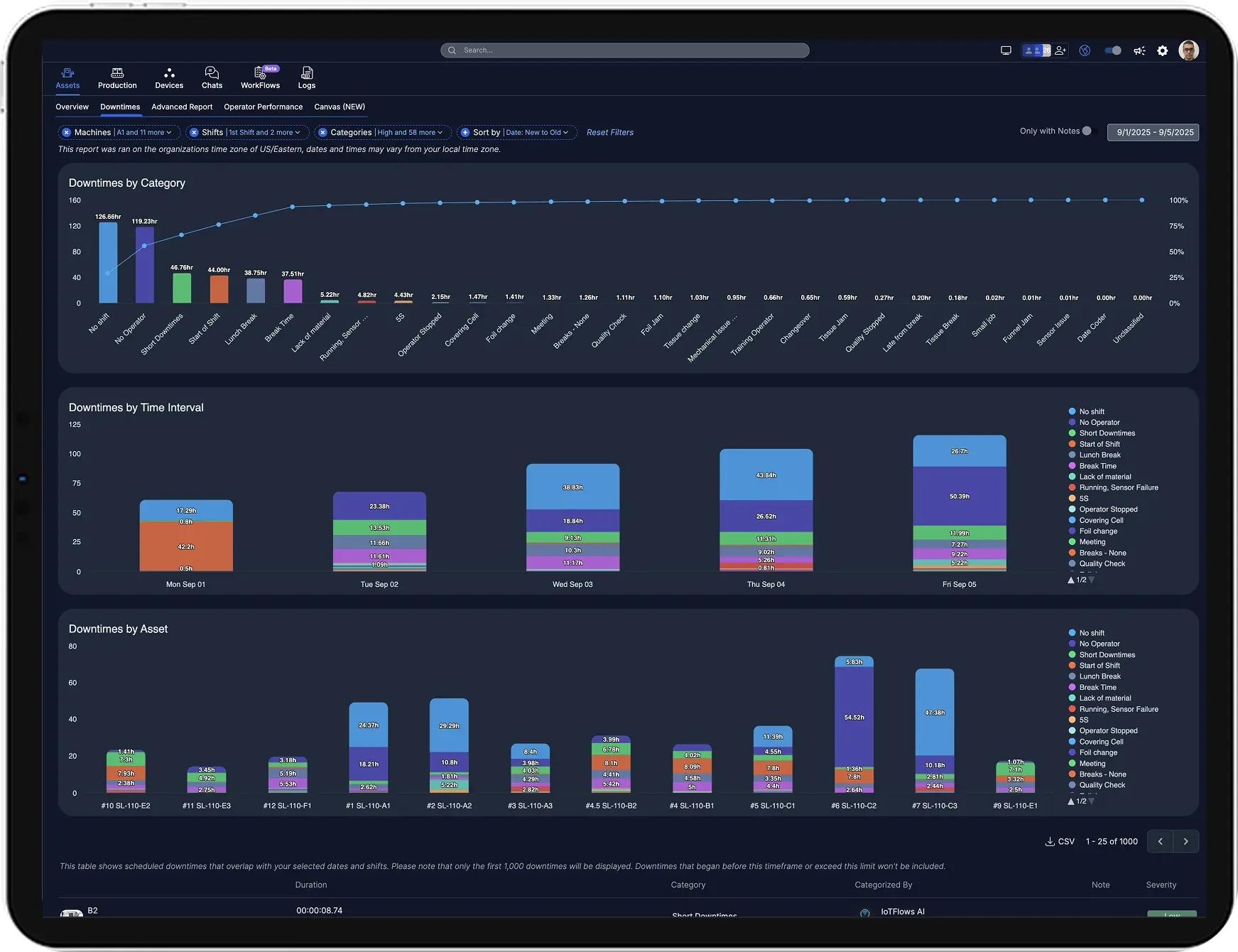
Knowing that a line went down is useful. Knowing why it went down is transformative.
The IoTFlows platform includes a full root cause analysis toolset built on Pareto analysis — the principle that roughly 80% of your downtime is caused by 20% of your problems. The platform automatically generates Pareto charts that rank your downtime reasons by total duration, helping you instantly identify the issues that are costing you the most.
What Is Root Cause Analysis in Manufacturing?
Root Cause Analysis (RCA) is a systematic process of identifying the fundamental reasons behind production problems rather than just treating symptoms. When a line goes down, the surface-level explanation might be "machine jam." But the root cause might be a worn conveyor belt, an out-of-spec incoming material, or an improper changeover procedure.
Effective RCA requires data — and lots of it. You need to track every downtime event, categorize it by reason, and analyze patterns over time. Which machine has the most stops? What shift experiences the most downtime? Is a particular failure mode getting worse?
Without an automated system doing this for you, RCA relies on operator memory and spreadsheet tracking — both of which are unreliable and labor-intensive. The IoTFlows platform handles it automatically.
The Platform Gives You:
- Downtime by Category — Pareto charts showing which problems cause the most lost time
- Downtime by Time Interval — Trend analysis showing whether problems are getting better or worse over days, weeks, months, and quarters
- Downtime by Asset — Machine-level breakdowns revealing which specific equipment needs the most attention
- Severity Classification — Categorize downtime events as high, medium, or low severity
- Operator Notes — Operators can add context and descriptions to downtime events via tablets or mobile devices stationed at the line
- Auto-Classification — Set up rules that automatically categorize common downtimes (shift changes, breaks, scheduled maintenance) without requiring operator input
Instant Alerts and Notifications
When something goes wrong, you shouldn't have to be staring at a dashboard to know about it. BeamTracker sends real-time alerts through multiple channels — email, push notifications, and SMS — so the right people are informed the moment an issue occurs.
You can configure alerts for any scenario: a machine has been down for more than 10 minutes, production rate has dropped below a threshold, a quality inspection is due based on parts count, or a shift target is falling behind schedule.
The API Advantage: Connect Your Insights Everywhere
For teams that want to go further, IoTFlows provides a comprehensive REST API, Webhooks, and MQTT integration options. This means your production data doesn't have to live in a silo.
Want to feed production counts into your ERP system? Connect downtime data to your CMMS for automatic work order generation? Push OEE metrics to a Power BI or Tableau dashboard? Build a custom integration with your proprietary scheduling software?
The API makes all of it possible — and it's included in every plan. Full API documentation is available at rest-api-docs.iotflows.com.
This is a crucial advantage over closed, proprietary monitoring systems. Your data belongs to you, and you should be able to use it however you need.
Real Results From Real Factories
Theory is one thing. Results are another.
Storm Power Components, an electronics manufacturer in Decatur, Tennessee, deployed BeamTracker alongside IoTFlows' SenseAi vibration sensors across their CNC machines, lasers, and presses. Before IoTFlows, their team leaders had no way to know which machines were running, idle, or having issues. Chemical bath processes relied on operator memory for timing, leading to inconsistent quality. Machine scheduling was based on gut feel rather than data.
After deployment, Storm Power Components doubled their machine utilization, eliminated chemical bath timing errors entirely, and implemented performance-based operator bonuses — all backed by real production data instead of guesswork.
Companies like Textron, Datwyler, Ranpak, Hilco Vision, and Criollos Foods are using IoTFlows across packaging, fabrication, food production, and precision manufacturing environments — proving that the approach works across industries and use cases.
The Economics: Why This Changes Everything
Let's compare the two approaches side by side.
Traditional PLC-Based Monitoring (Per Line)
| Category | Typical Cost |
|---|---|
| Systems integration & PLC programming | $20,000–$100,000+ |
| On-premise servers & networking | $10,000–$50,000 |
| Software licensing (annual) | $5,000–$30,000 |
| Ongoing IT support (annual) | $10,000–$25,000 |
| Implementation timeline | 3–12 months |
IoTFlows BeamTracker (Per Line)
| Category | Cost |
|---|---|
| BeamTracker hardware | $299 (one-time) |
| Cloud subscription | Starting at $99/month (annual plan) |
| Installation | 5–15 minutes, self-service |
| On-premise infrastructure | $0 |
| IT support required | None |
| Time to first insights | Same day |
The difference isn't incremental. It's an order of magnitude.
And because BeamTracker connects directly to the cloud via WiFi or 4G/LTE, there's no on-premise infrastructure to maintain, no servers to patch, no software to update. Firmware updates happen over the air, automatically.
Who Is BeamTracker For?
BeamTracker works with any industrial process where parts, products, or packages move through a defined path. If something passes a point on your line, BeamTracker can count it, time it, and report on it.
Common applications include:
- Packaging and fulfillment — monitor package counts, conveyor throughput, and sorting operations
- Assembly lines — track production output and cycle times across manual or automated stations
- Sheet metal fabrication — monitor press brake utilization, bending cycles, and operator efficiency
- Food and beverage — track filling, bottling, and packaging operations in FDA-regulated environments
- Robotic automation — measure robot cycle completion and pick-and-place operations
- Material handling — count items on conveyors and track inventory movement through distribution centers
Getting Started: It Really Is This Easy
If you've read this far and you're thinking "this sounds too good to be true" — I get it. After years of being told that production monitoring requires massive projects with massive budgets, a $299 sensor that you can set up in 15 minutes sounds almost suspicious.
But the technology genuinely has reached a point where this is possible. Cloud computing, wireless connectivity, precision LiDAR sensors, and AI-powered analytics have all matured enough to make plug-and-play industrial monitoring a reality.
Here's how to get started:
- Order a BeamTracker from iotflows.com/shop/products/beamtracker — it ships with everything you need, including the M12 power adapter and mounting hardware
- Create a free IoTFlows account at dashboard.iotflows.com
- Mount, power, and connect — follow the setup guide (most users are up and running in under 15 minutes)
- Start seeing your production data in real time from any device
IoTFlows also offers a 30-day money-back guarantee and a 1-year warranty on every device. And right now, you can use promo code PILOT75 to get 75% off hardware and subscription for the first two months — making it virtually risk-free to try.
If you'd prefer to see it in action first, you can request a sample or contact the sales team for a personalized demo.
The Bottom Line
Manufacturing is hard enough without flying blind. Every untracked downtime event, every mystery slowdown, every missed target — they all add up to real money left on the table.
The old way of solving this problem — PLC integrations, on-premise servers, six-figure budgets, and month-long implementation timelines — kept production intelligence out of reach for the vast majority of manufacturers.
IoTFlows BeamTracker changes that equation completely. A $299 sensor, a cloud subscription, 15 minutes of setup, and you have real-time production monitoring, OEE tracking, downtime analysis, root cause insights, and mobile alerts — accessible from anywhere, integrated with anything via API, and requiring zero IT infrastructure to maintain.
It's the kind of tool that makes you wonder why it took so long. But now that it's here, there's no reason to keep running in the dark.
Learn more about BeamTracker →
IoTFlows is headquartered in Atlanta, GA. Their products are used by manufacturers including Textron, Datwyler, Ranpak, Hilco Vision, Storm Power Components, and Criollos Foods. For more information, visit iotflows.com.